Thursday, March 21, 2013

Stereotypes in Comics


This week I read American Born Chinese by Gene Luen Yang. This novel is very interesting because it both involves the author's first hand account of constantly being judged for his Asian heritage as a child in a very realistic way while also dealing with some of the self hatred that comes along with years of being criticized for the way he looks and speaks with a character that is a very blatant racist Chinese stereotype. The novel was told in three separate stories that all converge at the end, but my favorite of the three was easily the autobiographical coming of age segments. Jin grows up constantly feeling like an outcast because of the cultural disconnect he has with his peers. His peers and teachers instantly dismiss him because of his race and his accent. When a person is being bullied, normally authority figures are the most obvious allies in the situation, but Jin shows on his first day of elementary school that this isn’t the case. His teacher instantly makes assumptions about him by mispronouncing his name and assuming he’s from China without any real care if she’s correct or not. To her Jin is just another Chinese student in her class. And that’s the main point the author is tries to drive home with the story of his childhood: That most people are willing to rely on stereotypes to explain others who are different from them because it’s much easier than trying to get to know a person. All of the negativity Jin receives for being a child of immigrant parents is absorbed to the point that he is just as mean to the next Chinese student that enters his class later on in school. Because when it comes down to it, Jin just wants to fit in. He wants to be accepted just like anyone else and that’s something that most of his peers just don’t want to put an effort into doing. Even though Jin understands exactly how alienated Wei-Chen feels as a new student from another culture, he initially distances himself from him just like everyone else in class.

 The self-hatred that the author felt as a child that is built up from so many years of bullying and feeling like an outcast is all dealt with through the “Everyone Ruvs Chin-Kee” portions of the novel. This story is told in the style of a traditional American sit-com where Danny is an all American kid living in a white suburban family. But things take a turn when Danny’s embarrassing cousin Chin-Kee comes to visit! Chin-Kee is depicted as a stereotypically racist image of a Chinese person. He has yellow skin, large buckteeth, permanently closed eyes, completely broken English, and he’s always wearing traditional garb. His race is played for laughs and absolutely no one takes him seriously. This is exactly the kind of image of an Asian person that you would find in a comic from the early 20th century, especially during WWII when propaganda was made to rally people against the Japanese. The Chin-Kee character is very uncomfortable to read and the story becomes pretty heartbreaking when it’s revealed that Danny is who Jin desperately wanted to be growing up. Because of the way he looks, many people just assumed Jin was like “Chin-Kee”. If he had been born with blonde hair and blue eyes his peers would have actually tried to get to know him. Jin even tries to become more like a “Danny” when he perms his hair to look like one of the more popular Caucasian boys in his class. While Chin-Kee is a very stereotypical character, he is used for a purpose to shine a light on how people treat people from different cultures. It should make you uncomfortable because we all know it’s wrong to judge people just on race and where they are from. But even if you aren’t blatantly a bully to someone, dismissing them can be just as hurtful.

Sunday, February 24, 2013

Maus


Maus is the story of a cartoonist who is documenting his father’s first hand account of the Holocaust. The author illustrate his father's story and he also illustrates the, at times difficult, process of getting his father to talk about his past. The story jumps back and forth between the present and the past . The artist telling his personal story brings an interesting perspective to the novel. Not only is this novel telling history in an original format, but the process of creating this book is also helping Artie understand his father. Their relationship has never been all that strong and through the creation of "Maus" Artie learns a great deal about the hardships his father had to survive in his youth. In his old age, Vladek is bitter, stingy, and very weak. He doesn't seem to love his 2nd wife and Arthur is stuck in the middle as his father and step mother come to him with their marital woes. The modern day family drama frames the Holocaust story and shows how surviving such a horrific situation has effects that last a life time. 

The choice to tell this story with animals is a very interesting decision. The novel starts with a quote by Hitler which says “The Jews are undoubtedly a race, but they are not human.” This must have sparked the original idea to depict the characters as rodents and other animals. I don’t think the decision trivializes the weight of the subject matter either. Scott McCloud explained that the more simplified a character is drawn, the easier it is to project yourself into the story. I think this idea is amplified even further when using animals as characters. People naturally personify animals in their lives everyday and I think that’s why we connect with comics and cartoons about talking animals so easily. There is a connotation with wholesome, mass appeal when a story is about talking animals and I think the stark contrast between those preconceived notions and the novel’s subject matter were a key part as to why the novel was told in this fashion. The mice are also very simplistic and don’t even have mouths to express with. The simple design allows the reader a lot of room to fill in the blanks with who these characters are.  Maus is truly unlike any other Holocaust survivor’s account and the style does not take away from the power of the story. The animals rarely took me out of the story except for a few (I’m assuming intentionally distracting) moments. For instance, there is a scene were Vladek tells the other prisoners that if he has to die he wants to be treated like a human being. It really drives home the point of how literally inhumane the Nazis are to the mice.

I guess one complaint I have with the novel is the fact that the characters were drawn simplistically to the point that you really can’t tell any of them a part. There would be scenes with entire families of people and the only distinguishing factor was when they were addressed by name. If there were only two characters in a scene the differences were fairly clear. Overall this was a fairly minor issue that didn’t ruin the novel by any means.  

It's very clear why this novel helped legitimize the graphic novel as a mature art form. It deals with a lot of mature themes and takes on one of the most painful events in human history. Along with the Holocaust, the novel has themes of suicide, post traumatic stress, and falling out of love. This novel takes it's subject matter very seriously and it pairs all of this with illustrations that are effective and possibly even deceptively simple. It's clear that most of the story is word for word what Arthur's father recited due to the broken english and Jewish dialect found throughout the story. This is a personal piece and true work of art that deserves all of it's critical acclaim. 

Sunday, February 17, 2013

Eisner


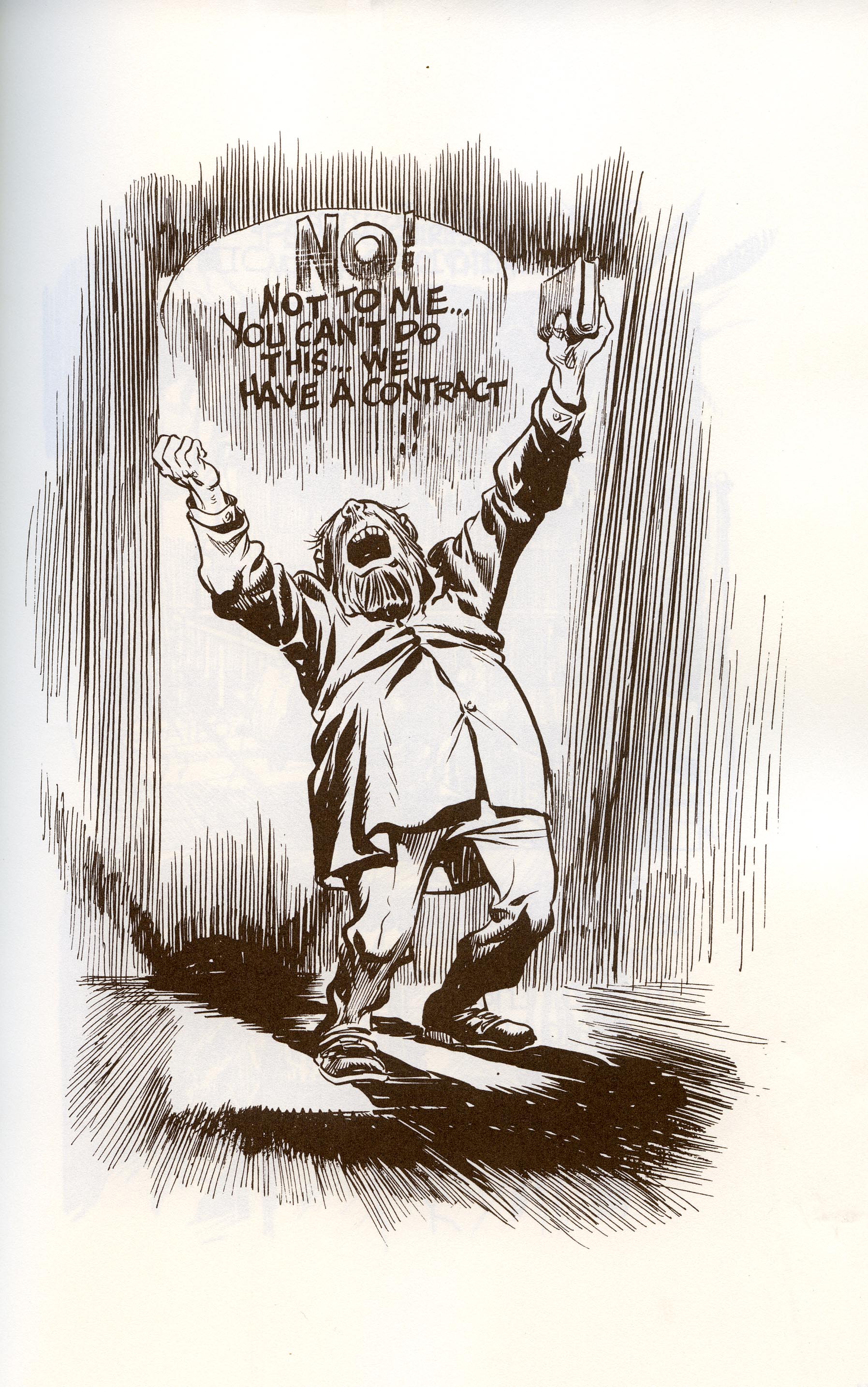
Will Eisner’s body of work helped legitimize the graphic novel as a relevant form of story telling and books like “Contract with God” show prove exactly why. The novel tells many short stories about people’s lives in neighborhood in the Bronx. Most of the characters are either miserable, vile, aggressive, or disgusting. There are no heroes in this book, just regular people dealing with life and their own personal demons. The subject matter alone sets this novel a part from traditional comic books but Eisner also pushes the boundaries of what comic book art can be. He illustrates only what is needed, sometimes only hinting at a background. There are very rarely any actual panels. He instead plays around with the organization of each image depending on what would best tell the story. For example, on the page where Hersh angryily tries to reason with God and suffers a heart attack, the panels are tilted as if they are coming undone. The heart attack panels are diagonal and overlapping one another which really builds the tension and represents that something is clearly not right. Some pages are just a full illustration and the format feels more like a political cartoon than a comic book.

 Eisner also uses font to tell the story. The letters on the page change size and style depending on what is being said. It makes the pages feel more alive. The words are just as involved in telling the story as the images are. The characters are also incredibly expressive. While the subject matter is very mature, the characters are still rather cartoony. And of course as Scott McCloud professes,  it’s easier to relate to images of people who are more simplified than those that are extremely specific and detailed. I’m sure Will Eisner was very keen on this fact and used it to his advantage. 

Sunday, February 3, 2013

The Comic Book

I read Weird Fantasy #13 from EC comics, which was a story about a comet that almost destroys the Earth before exploding. While the Earth remains intact, the radiation of the comet renders all mammals infertile and the comic chronicles the last human born on Earth. I had a lot of fun reading this story and I was genuinely invested in the plot. These short sci-fi scenarios remind me a lot of “Twilight Zone” episodes I used to watch as a kid. The ending really threw me for a loop. The story is very urgent and serious throughout the comic but the final reveal in the last panel is so incredibly silly that I couldn’t help but laugh at the absurdity. Adam, the last man born on Earth, and one of his scientific partners decide to create a portal to transport fertile people from the past to their future to repopulate the Earth. They are baffled when they only attract men through their door. Adam decides to enter the portal to see where all these 1950s women are and he is shocked to see that their portal was placed in a Men’s room. The final panel is essentially him lamenting the fact that he is too old and creepy to ever attract a woman into the portal. All of humanity is doomed because of a bathroom. Since this was my first Weird Fantasy story I didn’t know to expect such a silly punch line, but I was happily surprised.


I also noticed that almost every line in the comic ended with an exclamation point. This seems to be an ongoing trend in genre comics, especially adventure and super hero stories. The format made me read the words in my mind as if they were spoken in the urgent voice of a 1920’s newsreel. 

It’s also fun to see how the comic portrayed the near future. 2012, in this universe, promised flying cars and fashionable neon capes. It’s always fun to see how past generations envisioned our present, and how far we are from achieving it (especially the capes). 

The Comic Strip


This was easily the most nostalgic week because, like most of America, grew up always excited to read the comics in the Sunday newspaper. The pull out section of comics was like the main attraction of the entire paper. The panels were so colorful and there was such a wide range of fun characters and stories to choose from. One of my favorites growing up was Charles Shulz' Peanuts. Part of this was because I also grew up with all the Peanuts holiday specials and cartoons but a lot of my love for the characters came from the comic strips and the small truths they had to share. When you read a lot of Peanuts comics at once, you quickly realize that most of them are not intended to be all that funny. Sure a lot of them end with a traditional punch line, and you can always count of Snoopy for comic relief, but a lot of the time it's just a bunch of kids trying to deal with life's ups and downs. Charlie Brown is an average kid who always gets the short end of the stick. He tends to give things his all only to have mediocre results. Because of his experiences he has plenty of sad observations about the world that tend  to hit a little close to home as a reader. It's clear that the Peanuts comics were a vehicle for Charles Schulz to share some of personal philosophies with the world. Even though the target audience for these comics were children, Schulz trusted that kids would be able to handle characters dealing with realistic everyday problems. The world isn't always perfect and even children understand that and I think that's a major quality of Peanuts and why it has remained so popular.

While Charlie Brown may never be a star pitcher or a straight A student, there is one thing in his life he can always count on: his friends. Peanuts celebrates the importance of friendship and how necessary it is to have someone who can pick you up when life gets you down. All the characters have best pals that are never far from their side. For Charlie it's the quiet young philosopher Linus. Snoopy and Woodstock are constantly having adventures with each other and you rarely see Peppermint Patty without Marcy by her side. These strong friendships quickly build the world of Peanuts into something much deeper than a silly newspaper comic strip. These are characters with full lives and relationships and it has a relatable appeal that has kept the characters relevant to this day.

Thursday, January 10, 2013

Understanding Comics


“Understanding Comics” is a perfect blend of educational and informative literature. It delves into the psychology behind cartoons and how we relate to them in a way that I’ve never read before. The novel sparked a lot of “aha” moments when describing what makes cartoons and comics so appealing and I completely understand why this is known as the definitive book on comics.

An idea that I found fascinating is when Scott McCloud explained why it’s so easy to relate to cartoons. The more simplified a cartoon is, the easier it is to relate yourself to the character. He explains that the human brain takes in the appearance of others in vivid detail while our sense of self is more vague. We don’t see what we look like all the time. This is a concept that I’ve noticed for years but have never been able to explain. I see these principles all the time when I babysit. I can watch any cartoon with a group of kids and they will immediately start assigning who in the room is which character on the show. Regardless if the characters are crudely drawn or even a completely different species. They become instantly invested in what’s happening because they have made this connection to the character that they think best encompasses them. 

McCloud then makes the distinction between the sensory and conceptual world in cartoons. Everything in relation to us, or the character we are relating to, is a part of the conceptual experience while the objects and settings are sensory. This is why a lot of cartoons place their simplistically drawn characters in much more detailed worlds. The cartoon is the mask that we as the viewer are putting on and the world is a rich and exciting place for us to explore. This concept is used all over the place in animation and it’s even apparent in CG movies. For instance, in the movie Tangled, all of the characters are modeled to be stylized in a typical Disney fashion. They all have large expressive eyes and their faces aren’t too realistically textured with extraneous details like pores. Despite the character’s simplicity, the landscapes of the film are almost photorealistic. There are individual blades of grass in the fields and rays of sunlight shining through trees.


It’s exactly the aesthetic type that Scott McCloud describes in the graphic novel and now I understand why so many cartoons choose this technique. How could you not want to picnic in that forrest? This technique is so common place in comics and cartoons that you don't even think about it. "Understanding Comics" gave me the underlying meaning behind comic book conventions and my experience with the medium will become much richer because of it. 

Monday, January 7, 2013

Max Ernst

1. "Alas! My cobbler." The old maid flailed her arms in anguish as her kidney bean surprise fell from her lap. "Honey, I told you your knees are too fragile. I offered my wings..." clucked the chicken in disapproval. The couple had hit a rough patch after Mr. Chicken found the maid's male concubine at the bottom of the stairs earlier that morning.

2. "But if true love's kiss won't wake this fair maiden, what will?" The large chicken man began to sob.

3. The ceremonial burying-of-the-dairy maid was almost complete. "Now to set the girl on fire," cooed the rooster priest.

4. "I really don't think this woman goes with the decor." The badger nodded in agreement.

5. "I finished my thesis!" The scientist was too excited to notice his children's homicidal practices.